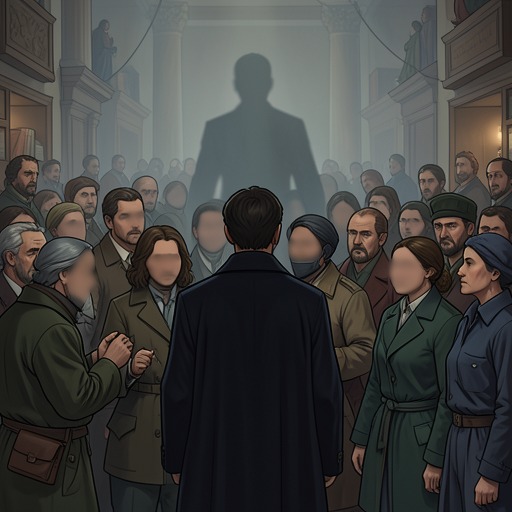
Jake Scully’s disappearance
Crimson LakeJake Scully’s disappearance is the case that brings Amanda Pharrell and Ted Conkaffey together as investigators. Its first details point not to a witnessed departure but to a household left behind: Scully’s wife reports waking to find him gone, while later examination of CCTV stills fixes his exit at 2:14 a.m. and shows a hurried, determined walk to his Jeep. The gap between those accounts makes the manner of his departure central to the search, even as its reason remains unresolved in the evidence presented here.
A Case Brought to the Investigators
Amanda introduces Scully as a missing local celebrity and identifies the matter as the Jake Scully case. As she begins, she removes a large ring from her finger; two smaller silver rings had been holding it in place, and the larger ring clunks against the table before Ted catches it. The object is identified as Jake Scully’s wedding ring. This first exchange makes the disappearance tangible before the investigators know its circumstances: a personal object passes between them as Amanda turns the missing-person case into a request for action.
Scully’s wife commissioned Amanda because she had lost confidence in Queensland Police’s handling of the search. Three weeks had passed without progress, and she was not being kept informed. She had the money to hire additional help, so Amanda brought the case to Ted and asked him to join the investigation. The private inquiry therefore begins amid both uncertainty about Scully’s whereabouts and dissatisfaction with the official response.
Stella’s Account of His Last Night
Stella Scully dates the last time she saw her husband to the night of January 21. They went to bed together at about ten in the evening after both had been drinking. She remembers Jake getting up some hours later but says she did not check the time; his getting up and moving around during the night was familiar to her. When she woke, he was gone. His wallet, keys, and phone were missing, and he had taken the Jeep, leaving the Jaguar in the garage.
Stella says she heard no knocking, conversation, or other indication that someone had called Jake out of bed. Her account establishes what the household could confirm in the morning, but not when or why he left. The distinction matters: his ordinary nighttime movements initially gave Stella no reason to treat his getting up as a warning, while the missing belongings and vehicle made clear that this was not simply an absence from the bedroom.
The Departure on Camera
Ted and Amanda examine phone records alongside still images from cameras outside the Scully home. The records show a burst of contact between Jake and another man about three months before he went missing, but those exchanges had stopped at 8:15 p.m. on the night he disappeared. There were no later texts in the records examined, and nothing there suggested that someone had summoned Jake from bed in the early hours.
The CCTV stills provide a more exact account of the departure. Although Queensland Police had taken the original tape into evidence, the investigators had copies of the still images. Across forty-one pictures, Jake walks the three or four metres from the house to the Jeep in the driveway, gets in, and drives away at 2:14 a.m. The sequence gives the departure a physical clarity absent from Stella’s memory of the night: his stride appears long and determined, his hand holding the keys is clenched, and he is in a hurry. The images establish that he left under his own power and took the Jeep; they do not establish where he went or what prompted him to leave.
What the Evidence Establishes
The disappearance is reconstructed from evidence gathered after the fact: Stella’s account, phone records, and repeated still images rather than a direct explanation from Jake. Together, they narrow the timeline from a husband missing when his wife wakes to a departure captured at a precise time, after the last recorded texts and before morning. Yet the central question remains open. The camera records Jake’s purposeful movement away from the house, but neither it nor Stella’s account supplies his destination or motive. The case begins with a visible exit and an invisible reason.